
Now Reading: HMDA Approval Check: Property Verification Checklist for HMDA Approval Check of Properties in Hyderabad, Telangana
-
01
HMDA Approval Check: Property Verification Checklist for HMDA Approval Check of Properties in Hyderabad, Telangana

HMDA Approval Check: Property Verification Checklist for HMDA Approval Check of Properties in Hyderabad, Telangana

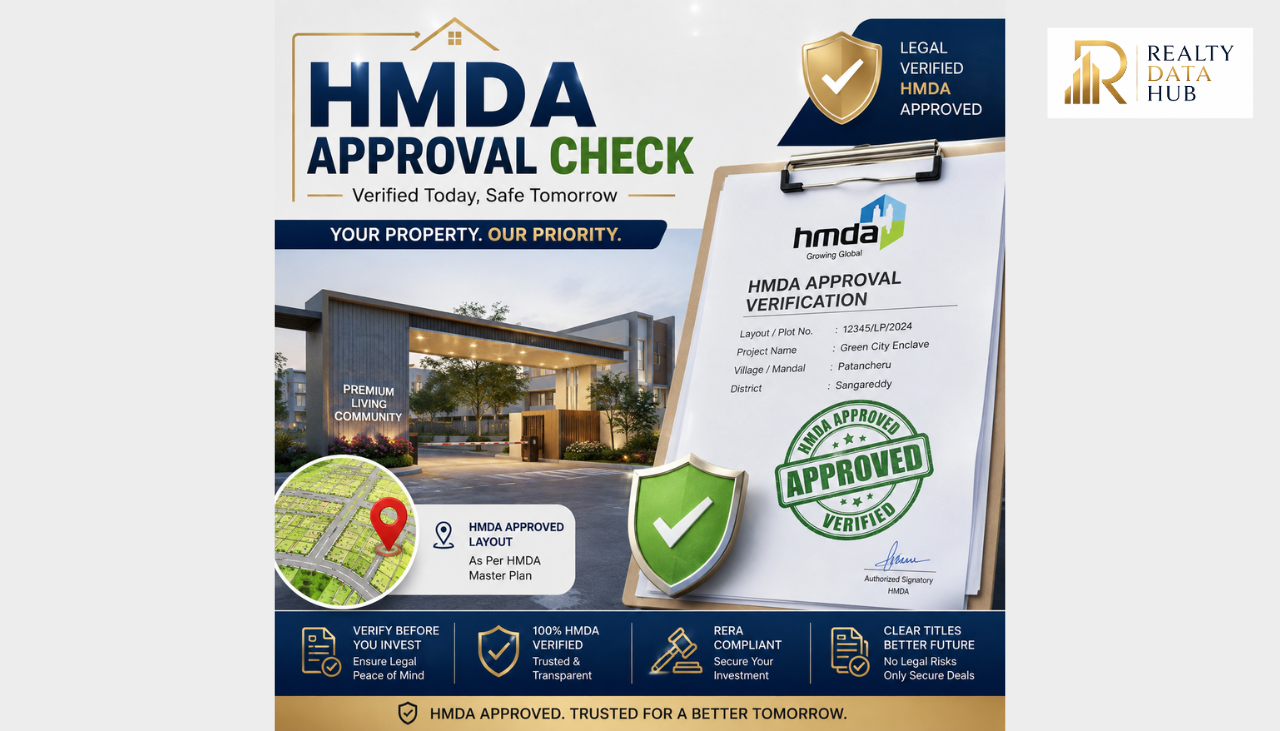
HMDA Approval Check is one of the most important steps before purchasing any residential or commercial property in Hyderabad, Telangana. A careful verification process helps buyers reduce legal risks, confirm ownership records, and ensure that the property complies with applicable planning and development regulations. Whether you are buying a plot, villa, apartment, or commercial space, conducting a thorough review of every document is essential. An informed decision is based on verified information rather than assumptions. Throughout the verification process, buyers should remember one key principle: Check the antecedents of the vendor(s) before proceeding with any financial commitment.
Why HMDA Approval Check Matters
The Hyderabad Metropolitan Development Authority (HMDA) regulates planned development across the metropolitan region. An HMDA-approved layout generally indicates that the development has complied with applicable planning norms and layout approval requirements. However, buyers should understand that approval alone does not replace complete legal due diligence.
Before making an advance payment, Check the antecedents of the vendor(s) to confirm that the seller has a legitimate right to transfer the property. This includes verifying ownership history, title documents, identity records, and the seller’s legal authority.
A complete property verification process protects buyers from disputes involving ownership, encroachments, unauthorized layouts, pending litigation, or incomplete documentation.
Essential Documents to Verify
A systematic review of documents can significantly reduce the chances of future complications. Buyers should collect copies of all available records and verify them carefully.
Important documents include:
- HMDA Layout Approval documents
- Registered Sale Deed
- Mother Deed
- Link Documents
- Encumbrance Certificate (EC)
- Property Tax Receipts
- Pattadar Passbook or Revenue Records where applicable
- Mutation Records
- Building Permission (if construction exists)
- Occupancy Certificate (where applicable)
- Approved Building Plan
- Identity proof of the seller
- Latest utility bills
- No Objection Certificates, wherever required
While examining these documents, always Check the antecedents of the vendor(s) to ensure that the documents genuinely belong to the seller and that there are no inconsistencies.
Verify Ownership History
Ownership verification is one of the most critical parts of property due diligence. Every transfer of ownership should be supported by registered documents that establish a continuous chain of title.
Buyers should verify:
- Original ownership
- Successive transfers
- Inheritance records, if applicable
- Gift deeds
- Partition deeds
- Court decrees affecting ownership
At every stage, Check the antecedents of the vendor(s) to confirm that each transfer was legally executed and properly registered.
Examine the Encumbrance Status
An Encumbrance Certificate provides information regarding registered financial liabilities and property transactions during a specified period.
The certificate helps identify:
- Existing mortgages
- Registered loans
- Property sales
- Gift registrations
- Lease registrations
- Legal claims reflected in registration records
Even if the Encumbrance Certificate appears clear, buyers should still Check the antecedents of the vendor(s) by reviewing supporting documentation and confirming the absence of unresolved disputes.
Confirm HMDA Layout Approval
One of the most important verification steps is confirming that the layout has received valid HMDA approval.
Verify:
- Approval number
- Layout plan
- Survey numbers
- Plot dimensions
- Open space reservations
- Road widths
- Land-use classification
A comparison between approved plans and the actual site helps identify deviations. During this stage, continue to Check the antecedents of the vendor(s) to ensure that the approved property matches the seller’s claims.
Verify Land Classification
The nature of the land determines whether development is permissible.
Buyers should verify whether the land is:
- Residential
- Commercial
- Mixed use
- Agricultural
- Government land
- Assigned land
- Ceiling surplus land
- Forest land
- Protected land
It is equally important to Check the antecedents of the vendor(s) to determine whether the seller possesses lawful ownership rights over the classified land.
Physical Site Inspection
Document verification should always be accompanied by a physical inspection.
During inspection, verify:
- Plot boundaries
- Survey stones
- Road access
- Encroachments
- Existing structures
- Drainage facilities
- Electricity connections
- Water supply
- Neighboring developments
Physical inspection can reveal differences between approved records and ground reality. While inspecting, Check the antecedents of the vendor(s) by confirming that neighboring property owners recognize the seller’s ownership and possession.
Investigate Pending Litigation
A property involved in legal proceedings may create future complications for buyers.
Review available information relating to:
- Civil disputes
- Partition suits
- Family disputes
- Injunction orders
- Property attachment
- Court decrees
- Recovery proceedings
In addition, Check the antecedents of the vendor(s) to identify whether the seller has been involved in recurring property-related disputes that could affect the transaction.
Financial Verification
Financial obligations connected with the property should also be reviewed.
Verify whether:
- Property taxes are fully paid
- Utility bills are current
- Maintenance charges are cleared
- Development charges are settled
- Betterment charges have been paid
- No outstanding government dues exist
Before completing payment, Check the antecedents of the vendor(s) to ensure that the seller has disclosed all financial liabilities associated with the property.
Building Approval Verification
If purchasing a constructed property, verify that the building complies with approved plans.
Review:
- Building permission
- Approved architectural drawings
- Occupancy Certificate
- Completion Certificate, where applicable
- Fire safety approvals, if required
- Structural compliance documentation
Alongside these checks, Check the antecedents of the vendor(s) to ensure that all construction approvals were legitimately obtained.
Importance of Professional Verification
Although buyers can review many documents independently, experienced legal professionals and technical experts can identify issues that may not be immediately obvious.
Professional verification may include:
- Legal title examination
- Survey verification
- Document authentication
- Registration review
- Municipal compliance review
- Technical inspections
Even after obtaining professional advice, buyers should still Check the antecedents of the vendor(s) as part of their independent due diligence.
Property Verification Checklist
Use the following checklist before purchasing any property:
| Verification Item | Status |
|---|---|
| HMDA Layout Approval verified | □ |
| Survey numbers confirmed | □ |
| Plot dimensions verified | □ |
| Original Sale Deed examined | □ |
| Mother Deed verified | □ |
| Link documents reviewed | □ |
| Encumbrance Certificate obtained | □ |
| Property tax receipts verified | □ |
| Mutation records checked | □ |
| Building approval verified | □ |
| Occupancy Certificate reviewed (if applicable) | □ |
| Utility bills verified | □ |
| Physical inspection completed | □ |
| Road access confirmed | □ |
| Encroachments checked | □ |
| Land classification verified | □ |
| Litigation search completed | □ |
| Identity of seller verified | □ |
| Financial liabilities reviewed | □ |
| Check the antecedents of the vendor(s) | □ |
| Legal opinion obtained | □ |
| Technical inspection completed | □ |
| Registration details confirmed | □ |
| Final document review completed | □ |
Final Thoughts
A successful property purchase begins with careful verification rather than hurried decision-making. Every document should be examined, every ownership record should be validated, and every approval should be confirmed through reliable sources. An organized verification process minimizes legal uncertainty and helps buyers make informed decisions regarding properties in Hyderabad, Telangana.
Most importantly, never overlook one of the fundamental principles of property due diligence: Check the antecedents of the vendor(s). This simple but essential practice should remain a priority before document verification, during ownership review, throughout financial examination, and before signing the final sale agreement. Consistently choosing to Check the antecedents of the vendor(s) can contribute significantly to a more secure and transparent property transaction.





Related Posts

Stay Informed With the Latest & Most Important News












Advertisement